Your Workshop Is Fighting the Weather — And Losing: A Climate-by-Climate Guide to Better Prints
You swapped out your nozzle. You dried your filament. You leveled the bed twice. And your prints are still warping, delaminating, or coming out with surfaces that look like the surface of the moon. Here's the thing nobody puts in the setup guide: your climate is doing more damage than your settings ever could.
The United States spans multiple climate zones — from the subtropical humidity of the Gulf Coast to the bone-dry heat of the Sonoran Desert to the arctic blast zones of the Upper Midwest. Every one of those environments creates a different set of challenges for additive manufacturing, and most makers are fighting those challenges blind. Let's change that.
Why Climate Matters More Than You Think
FDM and resin printing both depend on controlled thermal conditions. Filament extrusion relies on consistent melt temperatures and steady cooling. Resin curing depends on ambient temperature staying within a workable range. When your workshop environment swings outside those tolerances — even slightly — the results show up in your parts.
Humidity is the sneakiest villain. Hygroscopic filaments like nylon, TPU, and PETG absorb moisture from the air at the molecular level. Once that moisture is in the filament, it flash-vaporizes in the hot end, creating tiny bubbles and weak layer bonds. You'll hear it as a faint popping or crackling during extrusion. What you'll see is stringing, rough surfaces, and parts that snap under loads they should handle easily.
Temperature swings are the other big one. A garage shop in Chicago in January might hit 28°F overnight and 55°F by noon. That kind of fluctuation doesn't just affect your stored materials — it affects your printer's frame, your bed adhesion, and the cooling behavior of your parts mid-print.
The Gulf Coast and Southeast: Battling the Humidity Beast
If you're running a shop in Florida, Louisiana, Texas, or Georgia, you already know the air feels like a warm wet towel nine months out of the year. Relative humidity regularly clears 70–80%, and that's outside. Inside a non-climate-controlled workshop, it's not much better.
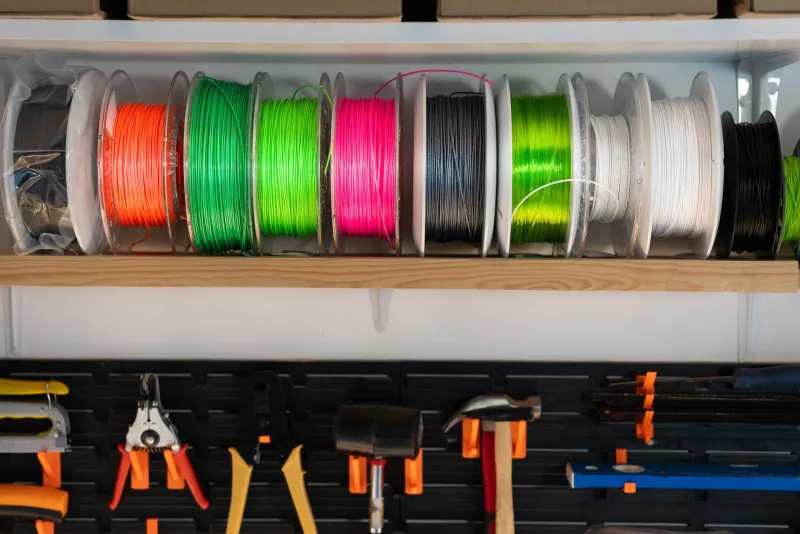
For makers in these zones, filament storage is non-negotiable. Sealed containers with desiccant packs are the baseline — not a nice-to-have. Consider investing in a dedicated filament dryer that runs continuously between print sessions, not just before you start. Brands like SUNLU and PrintDry offer units that hold multiple spools and maintain consistent low-humidity temps.
On the printer side, enclosures help retain heat around the print, but in a humid shop they can also trap moisture-laden air. Run a small silica gel pack inside your enclosure and swap it out weekly. For bed adhesion, PEI sheets tend to hold up better than blue tape or glue stick in high-humidity environments because they're less sensitive to moisture at the surface.
Resin printers in the Southeast face a different problem: UV curing efficiency drops when ambient temperatures fall below 70°F, which can happen during winter fronts. Keep a small space heater near your resin vat and aim for a consistent 75–80°F workspace during curing.
The Arid Southwest: Heat, UV, and Dry-Air Surprises
Phoenix, Las Vegas, Albuquerque — dry heat sounds like a maker's paradise compared to the Gulf Coast. Low humidity means your filament stays dry naturally, right? Mostly, yes. But arid climates bring their own print-wrecking quirks.
High ambient temperatures — workshops in Arizona can hit 95°F indoors in summer without AC — push your printer's cooling system harder. Hotend cooling fans may struggle to keep the heat break cold enough, leading to heat creep and jams. If you're in a hot-climate shop, consider upgrading to an all-metal hotend and adding supplemental airflow around the electronics bay.
Part cooling also behaves differently in dry heat. Faster evaporative cooling from low humidity can actually cause warping on large flat prints if the cooling is uneven. Slow your cooling fan down slightly and consider a brim on parts larger than 100mm to help them stay anchored.
UV exposure is a real concern for stored materials and finished parts in the Southwest. Keep filament away from windows and direct sunlight — UV degrades PLA faster than almost anything else, turning it brittle within months. For printed parts that will live outdoors in sunny climates, PETG and ASA are dramatically better choices than PLA.
The Upper Midwest and Mountain West: Cold, Dry, and Unforgiving
Minnesota in February. Colorado at altitude. The Pacific Northwest in a cold snap. These environments punish makers who don't account for cold ambient temperatures.
Cold workshops cause bed adhesion failures almost immediately. A print bed that reads 60°C on the sensor may actually be 50°C at the edges if the room is 40°F, because the heated bed is fighting the ambient temperature the whole time. Enclosures aren't optional here — they're essential. A basic enclosure made from foam board or an IKEA cabinet conversion can stabilize the print environment by 20–30°F over open-air printing.
PLA actually becomes more brittle in cold-printed environments. The layer bonds form differently when the ambient air is cold, and finished parts can crack under impact loads that warmer-climate prints would shrug off. If you're in a cold zone and making functional parts, lean toward PETG or ABS — both tolerate the thermal gradient better.
For resin printers in cold climates, the challenge is viscosity. Cold resin thickens, and thick resin doesn't spread properly across the FEP film, leading to failed prints and suction cup delamination. Store your resin at room temperature and consider a heated resin vat if your shop regularly drops below 65°F.
The Pacific Coast: Mild but Moody
San Francisco fog, Seattle drizzle, Portland's endless gray — the Pacific Coast sits in a moderate but persistently damp climate zone. Humidity swings seasonally and daily, and coastal salt air adds a corrosion factor that inland makers don't deal with.
The good news: extreme temperatures are rare, so thermal management is less intense. The challenge is consistent mid-range humidity (50–65% RH) that's high enough to affect hygroscopic filaments but not so obvious that makers notice until their prints start degrading.
A good digital hygrometer in your workshop is the first investment every coastal maker should make. Aim to keep your print space below 45% RH using a small dehumidifier, and store all opened filament in sealed containers regardless of material type.
The Universal Fixes That Work Everywhere
Regardless of your climate zone, a few upgrades pay dividends across the board:
- A quality hygrometer and thermometer in your workspace, checked before every print session
- Sealed filament storage with fresh desiccant — don't cheap out here
- An enclosure for any printer running ABS, ASA, nylon, or large PETG parts
- Consistent pre-print drying — 4–6 hours at the material manufacturer's recommended temp before starting a critical job
- Seasonal profile adjustments — the settings that work in August may not work in January in the same shop
Your printer doesn't know what month it is. That's your job. Once you start treating your climate as a variable you actively manage instead of a background condition you ignore, your print consistency will improve faster than any hardware upgrade could deliver.