That Pile of Failed Prints Is Costing You More Than You Think — Here's How to Fix It
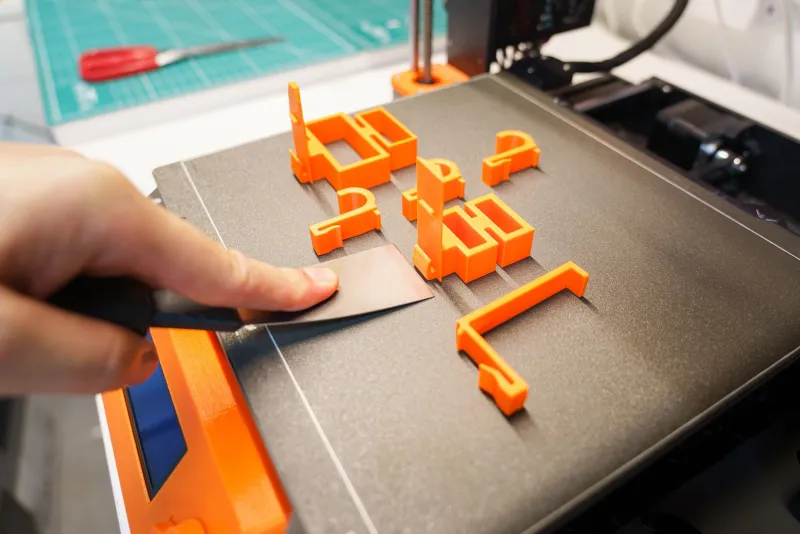
Walk through almost any active print shop in America and you'll find the same thing tucked in a corner: a bin, a bucket, or maybe just a growing pile of failed prints, support structures, purge blobs, and half-used spools. It's the quiet tax on every build — the material cost that never makes it onto an invoice because it never made it into a finished part.
Most makers treat it as the cost of doing business. A few pounds here, a few there. No big deal.
Except it kind of is. Run the numbers on a shop printing 40+ hours a week and that waste can add up to hundreds of dollars a month in material that got bought, got melted, and got thrown away. Multiply that over a year and you're looking at a real line item — one that most shop owners have simply stopped seeing.
The good news? A growing number of American makers are refusing to accept that math. Between domestic filament recycling programs and increasingly accessible in-house extrusion setups, the infrastructure to reclaim that material is more available than ever. You just have to know where to look.
Why Filament Waste Is Worse Than You're Accounting For
Here's a number that tends to surprise people: on a typical FDM print with supports and a raft, anywhere from 15 to 30 percent of your material never ends up in the final part. Add in failed first layers, test prints, calibration runs, and the occasional catastrophic spaghetti job, and the real waste rate in a busy shop can creep even higher.
For a shop running commodity PLA at $20–25 per kilogram, that might feel manageable. But shops moving into engineering-grade materials — PETG, ASA, nylon, carbon-fiber composites — are throwing away material that costs $60, $80, even $150 a kilo. At those prices, waste isn't a rounding error. It's a problem.
The other issue nobody talks about: landfill liability. Most thermoplastics don't biodegrade on any meaningful timeline. Dumping failed prints in the trash isn't just wasteful — it's increasingly at odds with how a lot of American makers think about their businesses and their communities.
The Domestic Recycling Option: Who's Actually Worth Partnering With
The simplest entry point for most shops is a third-party recycling program, and the domestic options have gotten meaningfully better over the last few years.
Filamentive and Refil have been operating in this space internationally, but stateside, outfits like Closed Loop Plastics and regional industrial plastic recyclers have started actively courting the maker community. The pitch is straightforward: ship us your clean, sorted scrap, and we'll either pay you by the pound or give you credit toward recycled-content filament.
The key word there is clean and sorted. Mixed materials — PLA with ABS with PETG all jumbled together — are essentially worthless to a recycler because the processing overhead kills the economics. If you want to make a recycling partnership work, you need to build sorting into your shop workflow from day one. Label your bins. Train whoever's pulling prints off the bed to drop waste in the right container. It sounds tedious, but it takes about two weeks to become habit.
For shops running high volumes of a single material — say, a production environment that's almost exclusively PLA or PETG — the math on selling sorted scrap can actually pencil out. A few shops running 10+ printers have reported offsetting 8–12 percent of their monthly material costs through scrap sales alone. Not life-changing, but not nothing either.
DIY Extrusion: Closing the Loop In-House
For makers who want more control — and a better return on their scrap — in-house filament extrusion is the other path. It's not for everyone, but the barrier to entry has dropped considerably.
Systems like the Felfil Evo and the Filastruder have been around for a while, but the newer generation of desktop extruders — including the Artme3D and several open-source builds circulating on maker forums — offer better diameter consistency, easier material handling, and more forgiving learning curves than the early gear.
The basic workflow: grind your failed prints into pellets or flake using a desktop shredder (the Filabot Reclaimer is popular, as is the Precious Plastic shredder design for DIYers), feed that material through the extruder, and spool the output for reuse. A good setup can produce filament in the $3–6 per kilogram range when you're feeding it scrap you'd otherwise toss.
The honest caveat here is consistency. Recycled filament — especially from mixed-batch scrap — tends to have more diameter variation than virgin material, and that inconsistency can translate into print quality issues on tight-tolerance work. Most makers who run in-house extrusion use their reclaimed filament for prototypes, jigs, test prints, and internal tooling rather than customer-facing parts. That's a smart division of labor: save your premium virgin material for production runs, and let the reclaimed stuff handle everything where perfection isn't the goal.
The Economics, Honestly
Let's be real about the numbers. A decent desktop shredder runs $300–600. A capable extruder is another $400–900. You're looking at $700 to $1,500 in upfront gear before you've reclaimed a single spool.
For a one-printer hobbyist, that math never works. But for a shop running five or more machines with meaningful daily throughput, the payback period on that equipment can be under a year — especially if you're working with higher-cost engineering materials.
There's also a less tangible value worth naming: material independence. Shops that can recycle and re-extrude their own filament are less exposed to supply chain swings and price spikes. That's been a real concern for American makers over the last few years as import costs and logistics disruptions have made material pricing unpredictable. Closing even part of your material loop is a hedge against that volatility.
Building It Into Your Operation
The makers who make recycling work don't treat it as a side project — they build it into their standard operating procedures. That means:
- Dedicated waste bins labeled by material type, positioned at every printer station
- Weekly or bi-weekly shredding sessions rather than letting scrap accumulate for months
- A clear policy on which reclaimed material goes to which jobs (prototype vs. production)
- Tracking scrap by weight so you actually know what you're reclaiming and what it's worth
None of this is complicated. It's just operational discipline — which, honestly, is true of most things that separate profitable shops from struggling ones.
The Bottom Line
That bin of failed prints isn't just waste. It's material you already paid for, sitting there waiting for a second chance. Whether you partner with a domestic recycler, invest in your own extrusion setup, or start with something as simple as sorting your scrap properly, there's real value in that pile — and real costs to ignoring it.
American makers built their reputation on resourcefulness. It's time to apply that same instinct to what comes off the build plate.